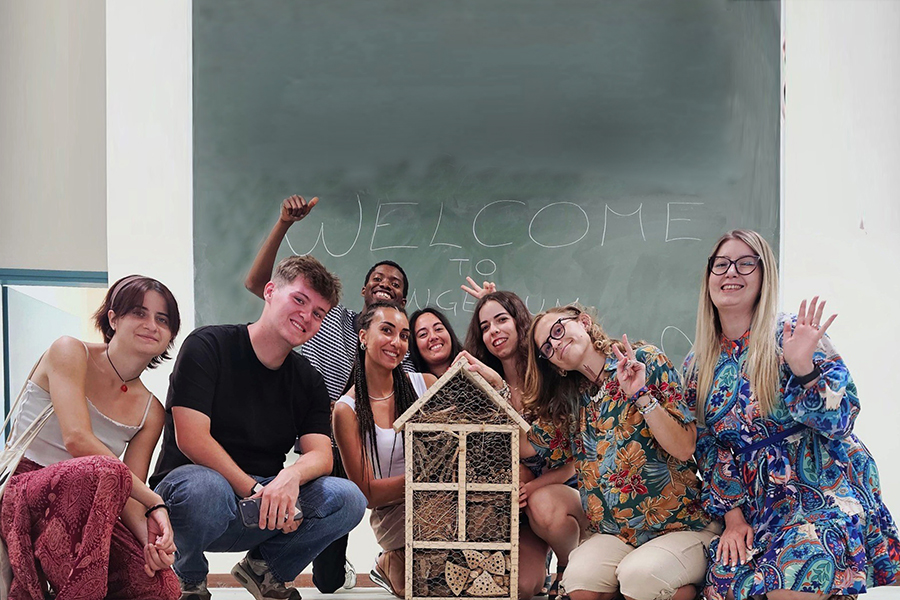
United by the motto “Health Promotion in the New Era,” more than 150 students and lecturers from the 10 partner universities of the INGENIUM Alliance participated in the event “10 Days of INGENIUM,” hosted by Medical University of Sofia from 1–5 June 2026.
The official opening ceremony took place at the Military Club in Sofia. In his welcoming speech, the Rector of MU-Sofia, Prof. Boycho Landzhov, MD, DMedSc, emphasized that “We are very proud because today’s event and the INGENIUM Alliance as a whole are a major step towards building a united European academic community, a community of shared values and a shared vision for the future.” Prof. Landzhov highlighted the importance of working within university networks in the context of modern development and the transformational processes taking place in scientific and educational institutions across Europe.
In his congratulatory address, the Vice-Rector of the University of Oviedo, Spain, and Vice-Rector of the coordinating institution of the INGENIUM Alliance, Mr Daniel Santos, stressed that MU-Sofia fully deserves to host this year’s final 10-day event. “The INGENIUM Alliance aims to bring together universities from different countries to share their educational approaches and facilitate student exchange. MU-Sofia has demonstrated energy and dedication in this regard. When a university with such strong traditions in medicine as MU-Sofia joins the Alliance, the university itself benefits, the country benefits, and Europe as a whole benefits,” noted Mr Santos.
The Dean of the Faculty of Public Health “Prof. Dr Tsekomir Vodenicharov, DMedSc”, Prof. Alexandrina Vodenicharova, MD, emphasized in her welcoming speech that through its participation in INGENIUM, MU-Sofia expands its academic exchange, promotes interdisciplinary cooperation, and creates new opportunities for education, research activities, and academic mobility. She stated that “INGENIUM reminds us that academic success is inseparable from human values – solidarity, diversity, integrity, and mutual respect.”
Greetings were also delivered by the Deputy Head of Mission of the Embassy of Italy in Bulgaria, Mr Edoardo di Paolo, the Deputy Mayor of Sofia and member of the Board of Trustees of MU-Sofia, Ms Nadezhda Bacheva, and the Vice-Rector of the National Sports Academy “Vasil Levski”, Assoc. Prof. Hristo Andonov.
As part of “10 Days of INGENIUM” at MU-Sofia, a Summer School for students was held, organized in the form of two Blended Intensive Programmes (BIPs). One of the BIPs was entitled “AI and Labour Market Transformation” and was aimed at students with an interest in the field of artificial intelligence. The topics presented by distinguished lecturers included the following aspects: The impact of AI and automation on employment and job quality; Emerging professions and skills in the digital economy; AI adoption across sectors such as manufacturing, services, and public administration; Inequality, inclusion, and the future of work; Ethical, legal, and policy challenges related to AI in the workplace.
The second BIP was entitled “Emergency Medicine in a Changing World.” The programme included the following thematic areas: Emergency care in the context of climate change, disasters, and extreme events; Digital technologies and innovation in emergency medicine (telemedicine, AI-supported diagnostics, decision support systems); Preparedness and response to pandemics and global health emergencies; Emergency medicine in ageing and diverse populations; Ethical, legal, and organizational challenges in emergency healthcare.
At the same time, a Staff Academy for administrative staff was held, focusing on discussions of the following topics: Effective student-centred learning equips students with knowledge and other professional and personal development skills. For example, collaborative learning, flipped classrooms, creative teaching methods, and reflective assessment; Connecting research, education, and working life promptly utilises research findings in education, bringing education and research closer together through challenge-based, work-based, and other methodologies. For example, simulations based on cutting-edge research, innovative work placements or internships, or new pedagogical theory or practice advances; Blended learning, or hybrid teaching, combines traditional classroom-based education with other innovative learning methodologies, including distance, digital, or work-based learning. This might include, for example, online learning environments, digital tools, and good blended teaching practices.
During the working meetings of the INGENIUM Executive Committee, attended by the leadership teams of the 10 partner universities, discussions focused on the long-term strategic perspectives of the European University INGENIUM.
As part of the five-day initiative, the INGENIUM Student Board held intensive working meetings during which current policies were discussed and specific proposals were outlined for the development of a plan for active communication among students both within and beyond the INGENIUM Alliance.
On the final day of the event, the Student Workgroups Presentations and INGENIUM Café took place, and the presentations selected by the jury according to predefined criteria were recognised and awarded.
The official closing of “10 Days of INGENIUM” was associated with the tradition of planting the INGENIUM Tree on the campus of the host university.